
Did the devils wears prada need to be done?
a review from a 13 going on 33-year-old fan

If you don’t know me, The Devil Wears Prada is 20% of my personality.
It has been since watching the first film at an intensely air conditioned theater in Palm Springs, California at the formative age of 13. (Don’t book shame me. I was only 10 when the novel came out).
If you don’t believe my fandom, the theme of my birthday last year was ‘Bring Bubbles and Watch the Devil’s Wears Prada on Repeat’. It was awesome.
The D Wears P is one of the only films I own on hard copy DVD. Which always came in handy whenever I moved into a new apartment. No WIFI, no streaming, no problem.
Because I had the hard copy, I had access to DVD bonus features: deleted scenes, interviews and behind the scenes footage of the making of the film. Those extra bits aided in my falling in love with the film, NYC, and the fashion industry, btw. (I’ll explain more later).
It’s the movie I watch when I’m celebrating something special, sick with the flu, or when I need some clarity in life. I always watch The D Wears P before I make a life-altering decision. And the resolution is always the same. Do the thing. Even if you fail, you’ll learn something new.
And not to brag, but people tell me I look a bit like Anne Hathaway, so perhaps I find solace in potentially mirroring her experiences.
I wouldn’t say I had journalistic ambitions, or even fashion focused dreams of working and living in NYC when I first saw the film at age 13, but I didn’t not have them. And I’d be lying if I said the characters, the plot twists, and the Paris trip didn’t influence decisions in later years.
The ‘NYC working in fashion editorial life’ portrayed in the film was one I came teasingly close to when I was 23. The same age as Anne Hathaway when she played the character of Andy, and the same age as Andy in the original novel. You see, I was granted an internship in the fashion closet of publication that would have changed everything. But I had a boyfriend at the time, a car payment and the belief that I wouldn’t make it. How silly of me. Why didn’t I listen to The D Wears P lesson I had been exposed to for 10 years? Do the thing; even if you fail, you’ll learn something new. Alas, I didn’t take the internship, or move to New York, but that version of my life that could have been still exists in my imagination. I am able to revisit that fantasy every time I watch film number 1. That’s why this sequel was so important to me.
BEFORE YOU GO ANY FURTHER THERE ARE SPOILERS.
If I had to sum up my D Wears P experience in one word, it would be almost.
Trust me, I’m more upset than you are.
I never expected there to be a sequel, nor did I want one.
I was content with my favorite movie, existing as a moment in time, not to be redesigned or reimagined.
But of course, I wasn’t not going to watch it.
THE FASHION
Overall, this film went way too fast. Between the dialogue, the music, the scene changes, the location changes; I couldn’t keep up. Perhaps I am a bit nostalgic for the 2006 aesthetic; the slow scenes, the pauses between lines, the still shots that allowed the audience to see the entire look of every character. I missed so many outfits, and can not recall any of the fashions. I only clocked two of Miranda’s statement coats, and Andy’s Hamptons dress, which got ample screen time.
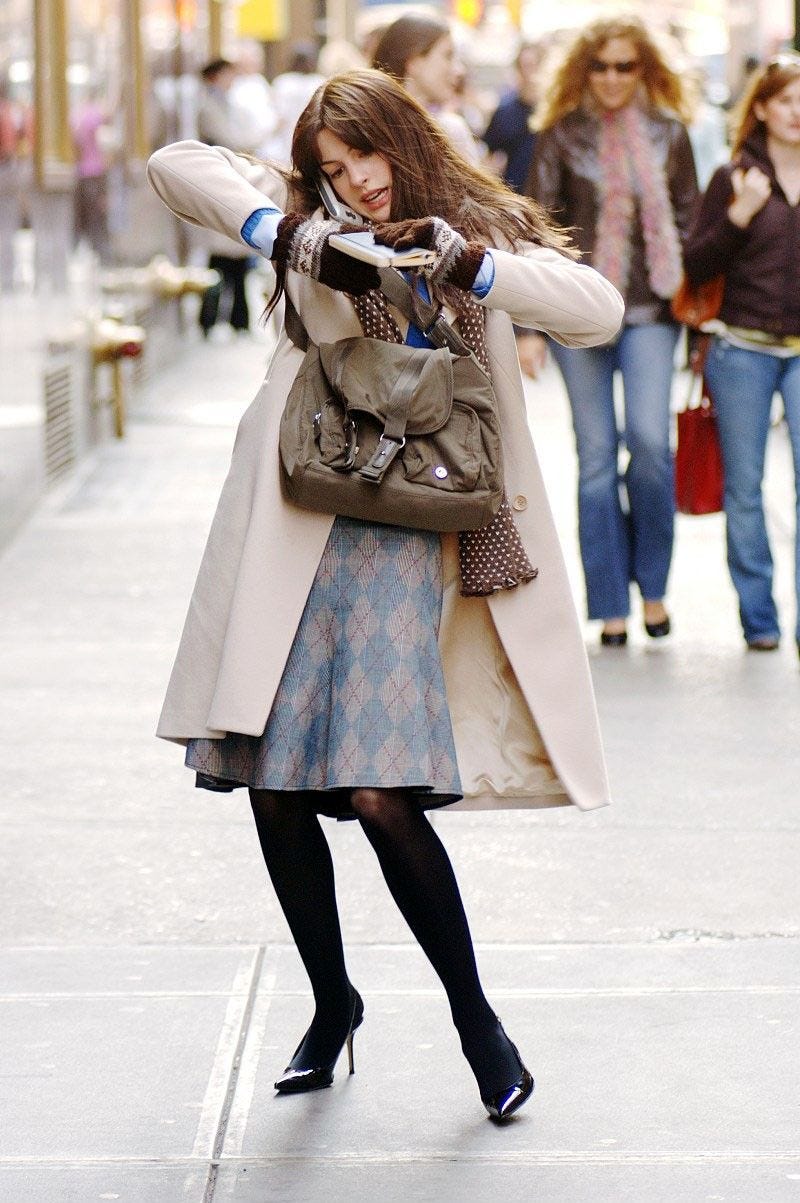
If you watched the bonus footage from the OG film (like me countless times) you’d know that fashion is considered a character in the film. Costume designer Patricia Field (also Sex and the City and (consulting for) Emily in Paris) describes her vision and artful eye for why she chose the pieces she did. Now remember, fashion is timeless, but trends move fast. Director David Frankel described the real challenge was curating looks that would mirror the moment (2006) but also stand the test of time. After watching the OG film the other night (for research of course), they nailed it. I’m personally still trying to replicate many of the fits, 20 years later. Glamour published an article saying the same thing, 10 years ago.
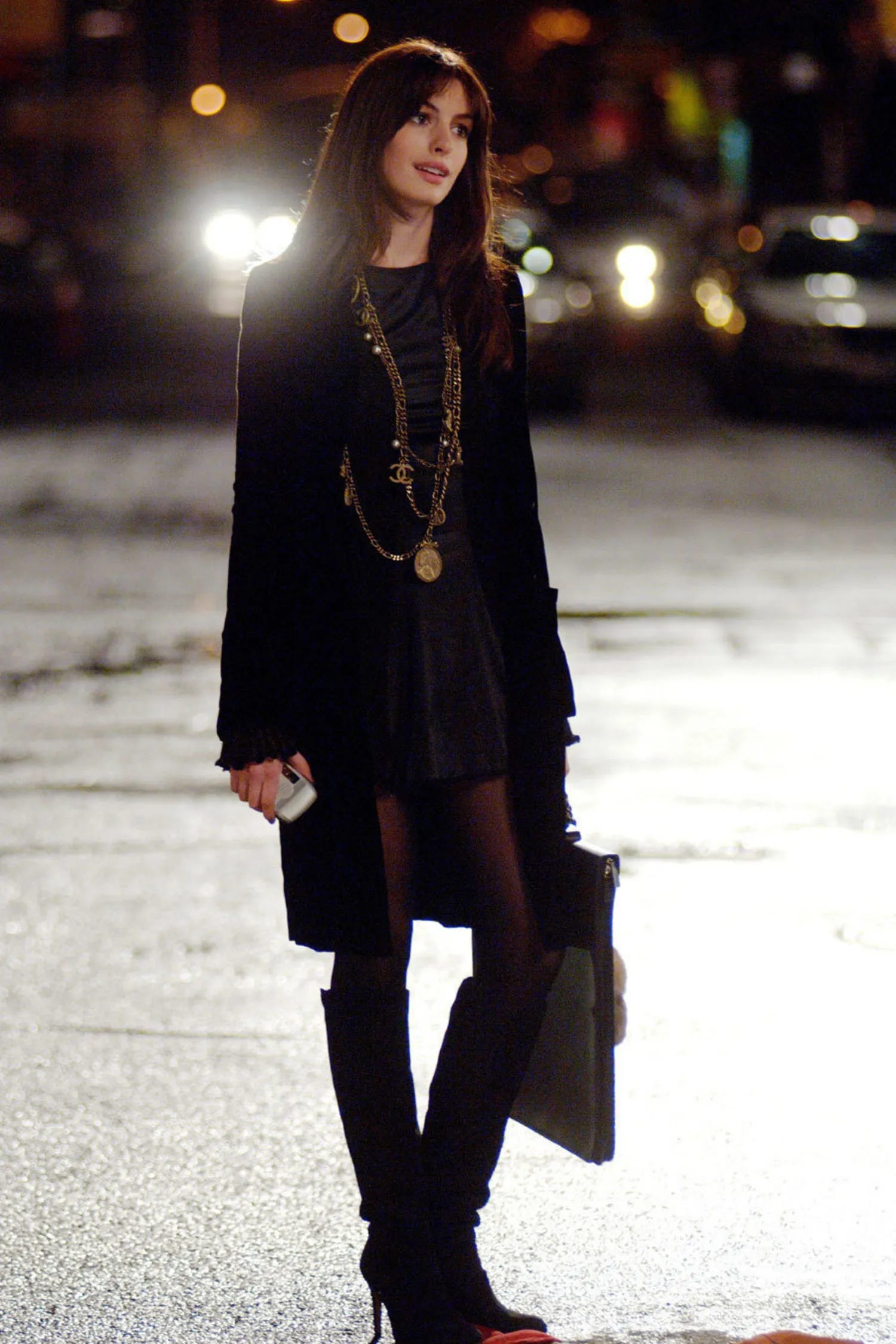
As for the fashions in this film, there is an obvious ode to the classics; such as the cerulean blue sweater from film 1 transformed into a distressed sweater vest worn in the last scene. But did you notice Andy’s somewhat statement look in the next to final scene? Jeans, jacket, boots and a bit of fringe. This look is similar to the one she dawns in the final scene of film 1 when she interviews for her job at the New York Mirror.
Another aspect of the fashion and filming choices in film 1 was the importance of shooting from the shoes up. I remember the bonus feature commentary stating these shoe shots were a very intentional part of filming. (You also see this a lot in Sex and the City.) Unfortunately, I saw very few shoes in this sequel.
There were also so many sequins, and I personally wanted more silk. However, there were a lot of references to thrifting pieces, which was great, sustainability is always in fashion.
THE STORY
I never thought I would say this as a lover of words, but there was too much dialogue. The speed of the film and the lack of intentional pauses in between dialogue made nostalgic for 2006. Even though it was incredibly fast, I was a bit bored. Multiple plots were introduced and before I had time to stress over the suspense, the solution was presented and the problem was resolved. I knew exactly how the movie was going to end from the start.
The first film told a story without telling us. Remember the iconic search for the next Harry Potter book scenes? There was hardly any dialogue at all, we had to wait and see if Andy would succeed. The first 3 minutes of the film #1 also had no dialogue. Through a monologue of women in NYC getting ready for work and the fashion choices they made, we understood exactly how little Andy would fit into the world she was about to enter. The onion bagel and subway ride alone said what words didn’t have to.
Sidenote: I’ve noticed a trend in films lately, not that I watch many in the theaters. In fact, this was the first film I watched IN theaters in about six years, truly. And for good reason. It took all of 5 seconds to remember why sitting in the cinema is not ideal for someone like me. The volume was loud as hell. During the commercials, I was forced to cover my ears with my pointer fingers. I know the commercials are always a bit louder than the film, so I waited to see if it got better. 30 seconds into the film, I almost walked out. I was so damn loud. I missed the first major plot point because I had to leave the theater and ask the attendant if they could possibly turn the volume down. It was 11am on a Wednesday, with 10 people in the theater. Someone did come and turn it down eventually, but I still muted the music with my finger every time a new song came on. It wasn’t exactly an enjoyable viewing experience.
This sequel recreated moments we all know and love, but unfortunately didn’t create any new ones. And I for one was desperate for some new inspirational messages, about fashion, media, writing, journalism, NYC, and icons.
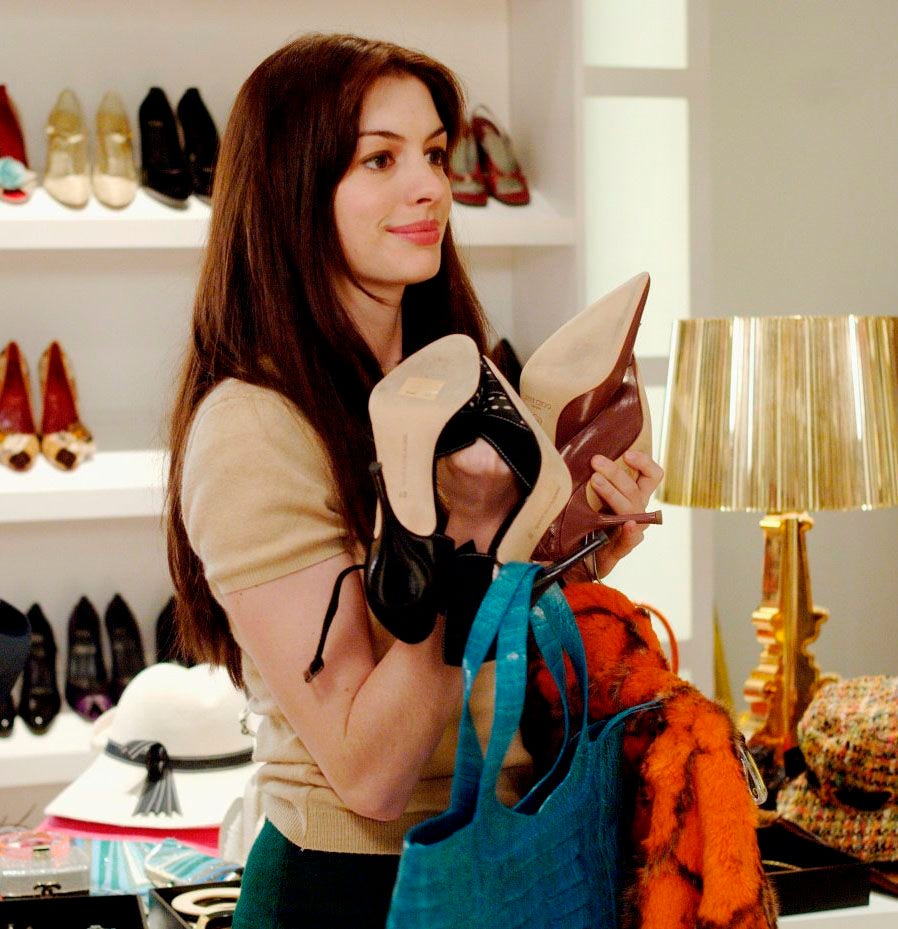
The searching for couture (for a size 6) was almost exactly the same, as was the riding in the car together scene at the end of the film. This was actually one of my favorites, and I’ll explain why below.
Devil is in the title, but there were no villains in this film. The obnoxious, yet ridiculously wealthy tech-titan is not an interesting character anymore, in fact it’s one I’ve seen a dozen times. Even when the truth comes out that Emily is actually the antagonist, and her devilishness is resolved quickly. I wanted a realistic villain, one we don’t necessarily need to forgive.
Speaking of forgiving, I am full force in experiencing a more human side of Miranda and Meryl Streep’s performance is flawless (as expected), but the writing for her character made her flimsy and watered down. There were moments of greatness, but the legendary HBIC (head bitch in charge) didn’t resonate the same with me, as the Miranda from 20 years ago.
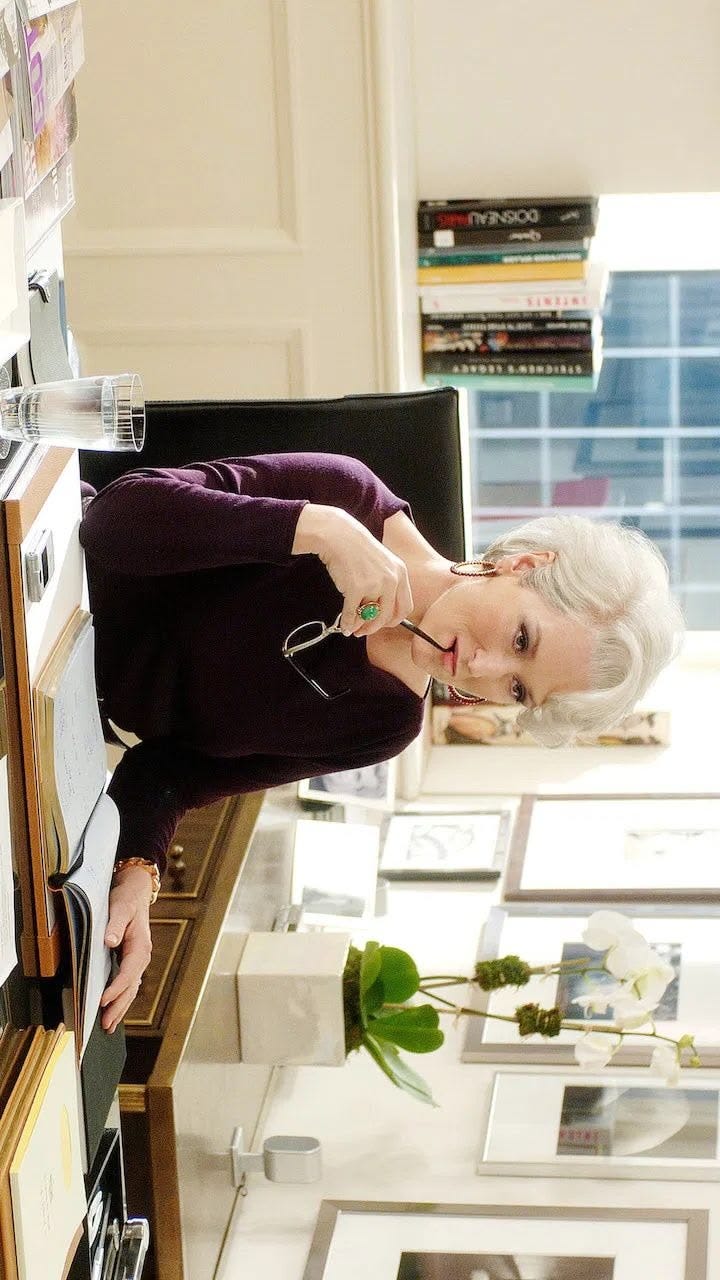
I consider myself creative, so I want to tap into the back story that I assume Meryl wrote for Miranda. If art imitates life, I imagine that over the course of 20 years, Miranda had to embrace drastic shifts in fashion, media and culture, and figure out how to stay relevant. The film explains that the fashion editorial industry is struggling just the same. Fashion media is no longer tangible and tear-worthy. When I say tear-worthy, I mean young girls like me tearing out the pages of magazines with models we aspired to look like, looks we wanted to recreate, styles we wanted to embrace and make our own. Fashion today, and the writing that is featured alongside it, is just as scrollable and temporary as the next thing. I can empathize with Miranda feeling exhausted and trying to make sense of seeing the world she built reduced to a social media post.
THE MESSAGE
This sequel had the opportunity to remind us all why fashion, features and art, and craftsmanship are so important to preserve. Unfortunately, that message wasn’t clear to me. And 20 years later at age 33, an unemployed aspiring writer, I am a bit desperate for inspiring messages. Especially from a film that made such a lasting impression on me during my youth.
There were no iconic monologues. We need more speeches!! Don’t get me wrong, I laughed out loud multiple times at one-liners from the entire cast, but there was only one iconic Miranda line that I can remember. I feel like I’ve spoiled the movie already but I won’t spoil the line.
If you remember from the first film the line “Don’t be silly, Andrea, everybody wants this. Everybody wants to be us.” Fun fact, which I learned from watching the bonus features, Meryl Streep suggested the line be changed from “Everybody wants to be me.” to “Everybody wants to be us.” That brilliant change established the tone for the entire movie. It transformed the film about her character into a love letter to the entire industry. I’m not sure about the tone of this sequel.
I did love the final-ish scene with Miranda and Andy in the same leather interior backseat as film one. Miranda confronts Andy with the truth behind her intentions for fighting for the company’s success, and I was there for it. Andy wasn’t helping save Runway for the sake of fashion or art or preserving a legendary publication, she was doing it to save her job, and her chance to be a writer. Finally a villain! A villain with a truth; one that we can all understand. Because can’t we all agree that at this moment in time, we will all do what we need to secure our livelihoods? Maybe that is the theme?
Will I watch this film again?
100%. Because what I learned from reading fashion magazines my entire childhood is that once through is never enough. For me, art is meant to be revisited, time and time again. No matter what the medium, art provides a new meaning, new answers, new ideas, every time you engage with it. Also, the person viewing the art is not stagnant. I am a great example of that. I will probably wait until I can purchase the film, so I can have access to it at my own speed, and my own volume. And so I can have the chance to pause and see the fashions and collect moments in their entirety. Maybe it will come out by the time I move into my new apartment and my tradition will continue!
Postscript
If you like what you read, please subscribe! Knowing that people are graciously subscribing to my weird litte writing universe is the biggest compliment and encourages me to keep going.
But to be honest, I’m not looking for subscribers, I’m looking for readers. I want to share ideas with like-minded people. Even though I am writing about food and wine, well, today fashion and film, I am also writing about me.
That is why I am a big fan of long-form writing and taking the time to read the long stories, the full story. I want to thank you in advance for reading mine.
As for right now, this newsletter is free. But my annual subscriptions are open and cost $30 a year. That’s $2.50 a month. With your support I can continue write stories about sustainable food, love, millennial musings and anything else that comes to mind.
Thank you for reading,
Tana